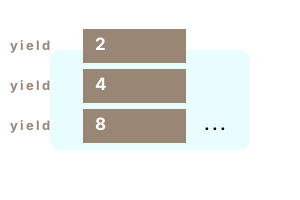
Yield. This C# keyword interacts with the foreach-loop. It is a contextual keyword: yield is a keyword only in certain statements. It can make loops clearer and simpler to write.
Yield allows each iteration in a foreach-loop to be generated only when needed. In this way (by enabling lazy evaluation) it can improve performance.
An example. We use yield in methods that return the type IEnumerable (without any angle brackets), or the type IEnumerable with a type parameter in the angle brackets.
Info We reference the System.Collections namespace for the first version, and the System.Collections.Generic namespace for the second.
Part 1 In the part of the foreach-loop following the "in" keyword, there is a method call to ComputePower.
Part 2 ComputePower() receives 2 parameters. It returns an IEnumerable int type, which we can use in a foreach-loop.
using System;
using System.Collections.Generic;
public class Program
{
static void Main()
{
// Part 1: compute powers of two with the exponent of 30.
foreach (int value in ComputePower(2, 30))
{
Console.WriteLine(value);
}
}
public static IEnumerable<int> ComputePower(int number, int exponent)
{
// Part 2: continue loop until the exponent count is reached.// ... Yield the current result.
int exponentNum = 0;
int numberResult = 1;
while (exponentNum < exponent)
{
// Multiply the result.
numberResult *= number;
exponentNum++;
// Return the result with yield.
yield return numberResult;
}
}
}2
4
8
16
32
64
128
256
512
1024
2048
4096
8192
16384
32768
65536
131072
262144
524288
1048576
2097152
4194304
8388608
16777216
33554432
67108864
134217728
268435456
536870912
1073741824
Internals. The C# code you have that uses yield is not directly executed by the runtime. Instead, the C# compiler transforms that code before the runtime ever occurs.
Tip The compiler-generated class, marked with CompilerGenerated, instead uses several integral types.
Result We see an entire class that is similar to how your code would look if you manually implemented the interfaces.
Info The punctuation characters allow the compiler to ensure no naming conflicts will occur with your code.
// Nested Types
[CompilerGenerated]
private sealed class <ComputePower>d__0 : IEnumerable<int>,
IEnumerable, IEnumerator<int> // ...
{
// Fields
private int <>1__state;
private int <>2__current;
public int <>3__exponent;
public int <>3__number;
private int <>l__initialThreadId;
public int <exponentNum>5__1;
public int <numberResult>5__2;
public int exponent;
public int number;
// Methods [omitted]
}
Benchmark, yield. Is yield return fast? Or does it incur a significant performance loss? Yield return does have some overhead, but if you need its advanced features it can be faster.
Version 1 This version of the code uses a foreach-loop over an array and multiplies each element.
Version 2 Here we use a yield return method (one that returns IEnumerable) to perform the multiplication.
Result The version that uses yield return runs many times slower. For simple things, avoid yield return for top speed.
using System;
using System.Collections.Generic;
using System.Diagnostics;
class Program
{
const int _max = 1000000;
static void Main()
{
int[] numbers = { 10, 20, 30, 40, 50 };
var s1 = Stopwatch.StartNew();
// Version 1: use foreach with array.
for (int i = 0; i < _max; i++)
{
if (Method1(numbers) != 300)
{
throw new Exception();
}
}
s1.Stop();
var s2 = Stopwatch.StartNew();
// Version 2: use foreach with yield keyword.
for (int i = 0; i < _max; i++)
{
if (Method2(numbers) != 300)
{
throw new Exception();
}
}
s2.Stop();
Console.WriteLine(((double)(s1.Elapsed.TotalMilliseconds * 1000000) / _max).ToString("0.00 ns"));
Console.WriteLine(((double)(s2.Elapsed.TotalMilliseconds * 1000000) / _max).ToString("0.00 ns"));
}
static int Method1(int[] numbers)
{
// Sum with simple statements.
int sum = 0;
foreach (int number in numbers)
{
sum += number * 2;
}
return sum;
}
static int Method2(int[] numbers)
{
// Use yield return to get multiplied numbers and then sum those.
int sum = 0;
foreach (int number in GetNumbers(numbers))
{
sum += number;
}
return sum;
}
static IEnumerable<int> GetNumbers(int[] numbers)
{
// Return all numbers multiplied.
foreach (int number in numbers)
{
yield return number * 2;
}
}
} 3.84 ns inline expression
50.68 ns yield return
Notes, IEnumerable. IEnumerable is an interface. It describes a type that implements the internal methods required for using foreach-loops.
Yield benefits. Suppose we have a large (or even infinite) set of items (like prime numbers, or species of beetles). Yield can provide a benefit here.
Tip We can just loop over items from the infinite set until we encounter one that matches our requirements.
And This reduces memory, reduces loading time of the set, and can also result in cleaner C# code.
Summary. We examined the yield return pattern. The yield keyword is contextual—it only has special significance in some places. It helps simplify foreach-loops.
Dot Net Perls is a collection of tested code examples. Pages are continually updated to stay current, with code correctness a top priority.
Sam Allen is passionate about computer languages. In the past, his work has been recommended by Apple and Microsoft and he has studied computers at a selective university in the United States.
This page was last updated on Jan 16, 2024 (edit).