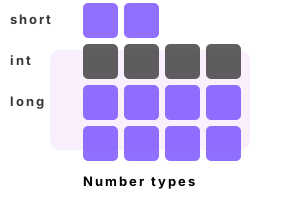
Short example. This example uses the short type as a storage location for positive or negative integers. The short type is aliased to the System.Int16 struct.
Here The program shows the memory usage of the short type on the managed heap, and its usage on the evaluation stack as a local variable.
Detail You can add values to a short local variable. This computation is expressed in the same way as adding numbers to integers.
Note The evaluation stack in the execution engine stores short types in the same memory size and slots as integers.
Important The short keyword is aliased to the "System.Int16" type. This mapping is referenced in the C# specification itself.
using System;
// Demonstrates a short value type used as local variable.
short number = 11;
Console.WriteLine(11);
number = -1; // Can be negative
Console.WriteLine(number);
Console.WriteLine(number == -1); // Can use == operator
Console.WriteLine(number + 100); // Can use + operator
Console.WriteLine(number.GetType());
Console.WriteLine(typeof(short));
Console.WriteLine(short.MinValue);
Console.WriteLine(short.MaxValue);
// Find the memory usage for a short value in a large array.
long bytes1 = GC.GetTotalMemory(false);
short[] array = new short[1000 * 1000];
array[0] = 1;
long bytes2 = GC.GetTotalMemory(false);
// Console.WriteLine(bytes1);// Console.WriteLine(bytes2);
Console.WriteLine(((bytes2 - bytes1) / (1000 * 1000)).ToString() +
" bytes per short");11
-1
True
99
System.Int16
System.Int16
-32768
32767
2 bytes per short
Short range. Consider the values returned by short.MinValue and short.MaxValue. The smallest number a short can hold is -32768. And the largest is 32767.
Parse shorts. This program uses 2 string literals as the input data: "100" and "100000." The value 100 can be stored in a short. The value 100000 cannot be.
using System;
class Program
{
static void Main()
{
const string value1 = "100";
const string value2 = "100000";
// Can use short.Parse.
short sh1 = short.Parse(value1);
Console.WriteLine("sh1 = {0}", sh1);
// Can use short.TryParse.
short sh2;
if (short.TryParse(value1, out sh2))
{
Console.WriteLine("sh2 = {0}", sh2);
}
// Returns false: short.TryParse on number too large.
short sh3;
if (short.TryParse(value2, out sh3))
{
Console.WriteLine("sh3 = {0}", sh3); // Never reached.
}
}
}sh1 = 100
sh2 = 100
Ushort example. The ushort type is a value type. This means the actual value of the variable is stored in its storage location memory.
Detail Local ushort variables are stored on the methods tack. The ushort type occupies 16 bits—it is half the size of an int value.
Detail The typeof operator uses an optimized reflection method to get the type pointer for an object type.
using System;
class Program
{
static void Main()
{
// Declare and initialize ushort value.
ushort value1 = 1000;
// This won't compile:// value1 = -1;// Write value.
Console.WriteLine(value1);
// Write type of ushort.
Console.WriteLine(typeof(ushort));
// Alternative syntax for declaring a ushort value.
UInt16 value2 = 1000;
// Write value.
Console.WriteLine(value2);
// Declare a ushort array.
ushort[] array1 = new ushort[2];
array1[0] = 5;
// Write array elements.
Console.WriteLine(array1[0]);
Console.WriteLine(array1[1]); // <-- Default is zero.// Write minimum and maximum values.
Console.WriteLine(ushort.MinValue);
Console.WriteLine(ushort.MaxValue);
}
}1000
System.UInt16
1000
5
0
0 <- Min
65535 <- Max
Ushort performance. If a ushort is smaller than an int, is it also faster to use? This program tests the performance of incrementing and looping with a ushort.
Version 1 The method loops over a ushort and increments one. The loop branches on a ushort (in a loop boundary test).
Version 2 This code uses int instead of ushort. It performs the same actions as the ushort method but with int.
Result It is faster to use an int in loops and increment statements. Ushort does not help runtime speed in this test.
using System;
using System.Diagnostics;
using System.Runtime.CompilerServices;
class Program
{
const int _max = 1000000;
static void Main()
{
// Version 1: use ushort method.
var s1 = Stopwatch.StartNew();
for (int i = 0; i < _max; i++)
{
Test1();
}
s1.Stop();
// Version 2: use int method.
var s2 = Stopwatch.StartNew();
for (int i = 0; i < _max; i++)
{
Test2();
}
s2.Stop();
Console.WriteLine(((double)(s1.Elapsed.TotalMilliseconds * 1000000) / _max).ToString("0.00 ns"));
Console.WriteLine(((double)(s2.Elapsed.TotalMilliseconds * 1000000) / _max).ToString("0.00 ns"));
}
static void Test1()
{
ushort result = 0;
for (ushort i = 0; i < 100; i++)
{
result++;
}
}
static void Test2()
{
int result = 0;
for (int i = 0; i < 100; i++)
{
result++;
}
}
}62.54 ns ushort method
35.68 ns int method
Ushort error. At compilation time, the C# compiler uses a checked context to check for overflow of numeric variables. It tries to detect an invalid program.
And It detects the assignment of a negative constant to the ushort variable, and gives you a helpful error.
Note This will help you avoid hard-to-find bugs later in the program's development.
class Program
{
static void Main()
{
ushort test = -1;
}
}Error CS0031
Constant value '-1' cannot be converted to a 'ushort'
Ushort advantages. Because ushort is only 16 bits, it will use about one-half the memory in an array as the int or uint type. In large arrays, this can improve performance.
Detail Programming languages use the "int" type to indicate the integer type that is fastest for the computer to use.
Notes, memory. A large array of shorts is half the physical size of a large array of ints. When a short element is read from an array, the runtime expands it to fit on the evaluation stack.
Also Using short local variables will not reduce memory usage. It may degrade performance.
BitArray. For many small values, a BitArray collection or an array of bool values is more compact than an array of ushort (or bool) values. A BitArray uses a single bit for each index.
A summary. Short and ushort are sometimes useful. Shorts can be used like native integers as local variables. In large arrays they will save memory usage over other types.
Dot Net Perls is a collection of tested code examples. Pages are continually updated to stay current, with code correctness a top priority.
Sam Allen is passionate about computer languages. In the past, his work has been recommended by Apple and Microsoft and he has studied computers at a selective university in the United States.
This page was last updated on Mar 22, 2023 (edit).