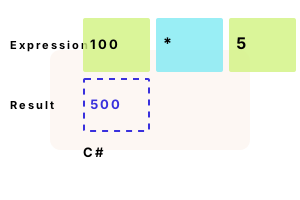
Multiply. The multiply operator is an asterisk. It computes the product of 2 numbers. Multiplication is a standard operation: C# is the same as other languages.
This operator obeys the operator precedence rules. So we can mix additions and multiplications and multiplication will come first.
An example. We compute the product of 2 operands using the multiplication operator. You can multiply any 2 numbers that can be implicitly converted to compatible types.
Info The C# language specification defines many predefined arguments (int, double) for the multiplication operator.
Here We compute the product of 100 and 5. The number 100 is a constant. The value 5 was determined at program runtime.
Note Because one value was not known at compile-time, the C# compiler cannot compute the product of the operands statically.
using System;
// Use a constant local and a dynamically// ... determined integer as operands.
const int operand1 = 100;
int operand2 = int.Parse("5");
// Compute the product and store it in a local variable.
int product = operand1 * operand2;
Console.WriteLine(product);
// You can check the value of a multiple expression in an if-statement.
if ((operand1 * operand2) == 500)
{
Console.WriteLine("Is equal");
}
// You can multiply a number against itself.
operand2 *= 2;
Console.WriteLine(operand2); // Now equal to 10 not 5.500
Is equal
10
Table. Next we write a multiplication table program. It uses two nested for-loops. The numbers we loop over are in the range 1 to 9.
Info In the innermost statement, we use the multiplication operator and then use a ToString format pattern.
Also A newline is printed at the end of each nine numbers in the loop. This improves the output format.
using System;
// Loop through all operands in the multiplication table.
for (int a = 1; a < 10; a++)
{
for (int b = 1; b < 10; b++)
{
// Write the multiplied number.
Console.Write((a * b).ToString("00 "));
}
// New line.
Console.WriteLine();
}01 02 03 04 05 06 07 08 09
02 04 06 08 10 12 14 16 18
03 06 09 12 15 18 21 24 27
04 08 12 16 20 24 28 32 36
05 10 15 20 25 30 35 40 45
06 12 18 24 30 36 42 48 54
07 14 21 28 35 42 49 56 63
08 16 24 32 40 48 56 64 72
09 18 27 36 45 54 63 72 81
Operator precedence. The multiplication operator has a greater precedence than plus or minus. The rules for operator precedence in the C# language are the same as those for arithmetic.
Tip The C# language has additional rules for coding-specific operators not found in regular mathematics.
Summary. We looked at multiplying numbers. The multiplication operator is the star character. The compound operator is represented by the "*=" characters.
Dot Net Perls is a collection of tested code examples. Pages are continually updated to stay current, with code correctness a top priority.
Sam Allen is passionate about computer languages. In the past, his work has been recommended by Apple and Microsoft and he has studied computers at a selective university in the United States.
This page was last updated on Oct 5, 2023 (simplify).