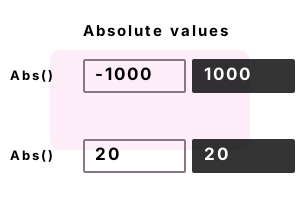
Tip The value returned from Math.Abs is of the same type as the value you pass to it.
So If you pass a Double as the argument to Math.Abs, it also returns a Double.
Module Module1
Sub Main()
' Absolute values of integers.
Dim value1 As Integer = -1000
Dim value2 As Integer = 20
Dim abs1 As Integer = Math.Abs(value1)
Dim abs2 As Integer = Math.Abs(value2)
Console.WriteLine(value1)
Console.WriteLine(abs1)
Console.WriteLine(value2)
Console.WriteLine(abs2)
' Absolute values of doubles.
Dim value3 As Double = -100.123
Dim value4 As Double = 20.2
Dim abs3 As Double = Math.Abs(value3)
Dim abs4 As Double = Math.Abs(value4)
Console.WriteLine(value3)
Console.WriteLine(abs3)
Console.WriteLine(value4)
Console.WriteLine(abs4)
End Sub
End Module-1000
1000
20
20
-100.123
100.123
20.2
20.2
Internals. The internal code of Math.Abs depends on the value type. On some types, such as Integer, the function simply tests for a negative number and then negates it.
Also For types such as Decimal and Double, other methods are internally called.
Summary. Computing absolute values of a number is useful in many programs. It is useful even in functions that compute hashes. The .NET Math.Abs function is convenient and well-tested.
Dot Net Perls is a collection of tested code examples. Pages are continually updated to stay current, with code correctness a top priority.
Sam Allen is passionate about computer languages. In the past, his work has been recommended by Apple and Microsoft and he has studied computers at a selective university in the United States.
This page was last updated on Oct 26, 2021 (image).