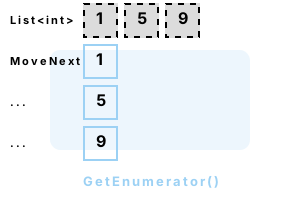
GetEnumerator. Some .NET collection types offer the GetEnumerator method. This method returns an Enumerator object that can be used to loop through the collection.
Complete knowledge of the actual collection type is not needed. We can use GetEnumerator in a while-loop, and call MoveNext on each iteration.
Thus We only require one Write method to handle all generic enumerators that handle integers.
using System;
using System.Collections.Generic;
class Program
{
static void Main()
{
List<int> list = new List<int>();
list.Add(1);
list.Add(5);
list.Add(9);
List<int>.Enumerator e = list.GetEnumerator();
Write(e);
}
static void Write(IEnumerator<int> e)
{
while (e.MoveNext())
{
int value = e.Current;
Console.WriteLine(value);
}
}
}1
5
9
GetEnumerator benchmark. We can write methods that work on IEnumerator, but is this efficient in .NET 7 in 2022? This benchmark tests GetEnumerator performance.
Version 1 This version of the code uses MoveNext on an IEnumerator interface to sum up a List of integers.
Version 2 Here we use foreach on a List of integers directly and sum up all the values. The result is the same as version 1.
Result Even with .NET 7 in 2022, it is faster to use simpler looping constructs like for and foreach over enumerators.
using System;
using System.Collections.Generic;
using System.Diagnostics;
class Program
{
static int CountMoveNext(IEnumerator<int> e)
{
int count = 0;
while (e.MoveNext())
{
int value = e.Current;
count += value;
}
return count;
}
static int CountForeach(List<int> e)
{
int count = 0;
foreach (int value in e)
{
count += value;
}
return count;
}
const int _max = 1000000;
static void Main()
{
List<int> list = new List<int>();
list.Add(1);
list.Add(5);
list.Add(9);
List<int>.Enumerator e = list.GetEnumerator();
var s1 = Stopwatch.StartNew();
// Version 1: use MoveNext.
for (int i = 0; i < _max; i++)
{
var result = CountMoveNext(e);
}
s1.Stop();
var s2 = Stopwatch.StartNew();
// Version 2: use foreach.
for (int i = 0; i < _max; i++)
{
var result = CountForeach(list);
}
s2.Stop();
Console.WriteLine(((double)(s1.Elapsed.TotalMilliseconds * 1000000) / _max).ToString("0.00 ns"));
Console.WriteLine(((double)(s2.Elapsed.TotalMilliseconds * 1000000) / _max).ToString("0.00 ns"));
}
}26.71 ns CountMoveNext
14.79 ns CountForeach
Summary. GetEnumerator is an instance method provided on many collection types. A unified method can be used to loop over the Enumerator returned by all these collections.
Dot Net Perls is a collection of tested code examples. Pages are continually updated to stay current, with code correctness a top priority.
Sam Allen is passionate about computer languages. In the past, his work has been recommended by Apple and Microsoft and he has studied computers at a selective university in the United States.
This page was last updated on Oct 12, 2022 (new example).