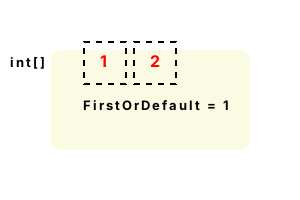
Simple example. Here we show what happens when FirstOrDefault is used on a non-empty collection, and then an empty collection. If a collection is empty, a default value is returned.
using System;
using System.Linq;
int[] test = { 1, 2 };
Console.WriteLine("FIRST OR DEFAULT: {0}", test.FirstOrDefault());
int[] test2 = new int[0];
Console.WriteLine("FIRST OR DEFAULT: {0}", test2.FirstOrDefault());FIRST OR DEFAULT: 1
FIRST OR DEFAULT: 0
Complex example. The System.Linq namespace is required to use FirstOrDefault. The FirstOrDefault method can be used on any type that implements IEnumerable.
Part 1 The first time FirstOrDefault is invoked, it returns the value of the first string element in the List.
Part 2 The second time it is called, it returns null because the "query1" expression returned no elements.
Part 3 The third usage returns the string literal "Mouse" because that is the first element that matches the "where" clause in the query.
Part 4 The program displays 0 because that is the result of FirstOrDefault when called on an empty integer array.
using System;
using System.Collections.Generic;
using System.Linq;
// Part 1: this List has 3 elements.
var list = new List<string>() { "Cat", "Rat", "Mouse" };
Console.WriteLine(list.FirstOrDefault());
// Part 2: this query produces no results so FirstOrDefault is null.
var query1 = from element in list
where element.Length > 10
select element;
Console.WriteLine(query1.FirstOrDefault() == null);
// Part 3: this query produces one result, so FirstOrDefault is a string.
var query2 = from element in list
where element.Length > 3
select element;
Console.WriteLine(query2.FirstOrDefault());
// Part 4: this array has no elements, so FirstOrDefault is zero.
int[] array = new int[0];
Console.WriteLine(array.FirstOrDefault());Cat
True
Mouse
0
Internals. The FirstOrDefault method is an extension method. It is a generic method which means it accepts a type parameter that indicates what types it acts upon.
Tip You do not need to specify the type parameter because this is inferred during the C# compilation step.
Detail It checks the acting collection for null, and if that is true it returns the result of the default(T) expression.
And Otherwise, it returns the element at index 0 of the element iterated to first.
Default expression. The C# language provides a default expression, which the FirstOrDefault method refers to. This expression is similar to the typeof operator.
Info The default value for a value type is equal to all zero bits. And the default value for a reference type is the null value.
A summary. FirstOrDefault is a way to access the "best match" from a query expression that sorts and filters elements. It protects against invalid accesses.
Dot Net Perls is a collection of tested code examples. Pages are continually updated to stay current, with code correctness a top priority.
Sam Allen is passionate about computer languages. In the past, his work has been recommended by Apple and Microsoft and he has studied computers at a selective university in the United States.
This page was last updated on Nov 29, 2023 (edit).