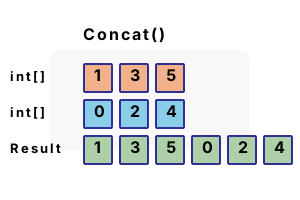
Example. In this program, we include the System.Linq namespace to get access to the Concat method. Two arrays are created upon execution of the Main method.
Then We call the Concat method twice, in different orders, and display the results.
Tip If you have ever needed to write custom code to combine two arrays or Lists into a single one, the Concat method might be useful.
using System;
using System.Collections.Generic;
using System.Linq;
List<string> list1 = new List<string>();
list1.Add("dot");
list1.Add("net");
List<string> list2 = new List<string>();
list2.Add("perls");
list2.Add("!");
var result = list1.Concat(list2);
List<string> resultList = result.ToList();
foreach (var entry in resultList)
{
Console.WriteLine(entry);
}dot
net
perls
!
Summary. If you have two Lists, you can use the Concat method to combine them. For optimal performance, however, using a method such as AddRange would be better if you need a List result.
Much like string.Concat concatenates strings, the Concat extension concatenates collections. Whenever we need to combine two arrays into a third array, we use the Concat extension method.
Dot Net Perls is a collection of tested code examples. Pages are continually updated to stay current, with code correctness a top priority.
Sam Allen is passionate about computer languages. In the past, his work has been recommended by Apple and Microsoft and he has studied computers at a selective university in the United States.
This page was last updated on Mar 28, 2024 (edit).