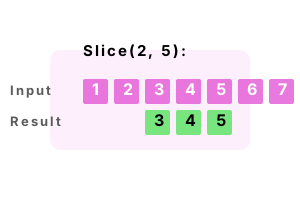
Input and output. Consider an array of integers. We wish to take a slice of a certain range of integers. The first argument is the start index, and the second is the last index (exclusive).
Slice(2, 5):
1
2
3
4
5
6
7
Example. Here we see a generic method, which lets it act on any type. Our Slice method here uses this ability to simulate the built-in slice functionality of Python and other languages.
Detail This class contains a public static method called Slice. The Slice method is an extension method.
Also The other confusing part is the use of the letter T. The Type T is replaced by the C# compiler with any type you specify.
using System;
using System.Collections.Generic;
class Program
{
static void Main()
{
int[] a = new int[]
{
1,
2,
3,
4,
5,
6,
7
};
foreach (int i in a.Slice(0, 1))
{
Console.WriteLine(i);
}
Console.WriteLine();
foreach (int i in a.Slice(0, 2))
{
Console.WriteLine(i);
}
Console.WriteLine();
foreach (int i in a.Slice(2, 5))
{
Console.WriteLine(i);
}
Console.WriteLine();
foreach (int i in a.Slice(2, -3))
{
Console.WriteLine(i);
}
}
}
public static class Extensions
{
/// <summary>/// Get the array slice between the two indexes./// ... Inclusive for start index, exclusive for end index./// </summary>
public static T[] Slice<T>(this T[] source, int start, int end)
{
// Handles negative ends.
if (end < 0)
{
end = source.Length + end;
}
int len = end - start;
// Return new array.
T[] res = new T[len];
for (int i = 0; i < len; i++)
{
res[i] = source[i + start];
}
return res;
}
}1
1
2
3
4
5
3
4
Notes, generics. When T (or a similar letter) appears in brackets after a method name, this is a generic method. The letter is replaced with the type specified.
A discussion. How is this method different from LINQ Take and Skip? The method here can deal with negative parameters. And it may be faster because it doesn't use IEnumerable.
A summary. Here we saw a generic array slice method that is also an extension method. An extension method is appropriate as the method can be used throughout a project.
Dot Net Perls is a collection of tested code examples. Pages are continually updated to stay current, with code correctness a top priority.
Sam Allen is passionate about computer languages. In the past, his work has been recommended by Apple and Microsoft and he has studied computers at a selective university in the United States.
This page was last updated on Oct 25, 2022 (simplify).