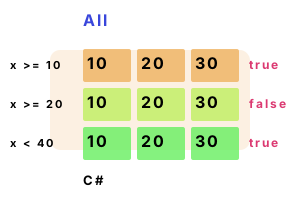
All. This is a C# extension method. It tells us if all the elements in a collection match a certain condition. It returns true or false.
System.Linq. All() is part of the System.Linq namespace in .NET. We often want to call All() on the result of a query expression using other LINQ features.
An example. To begin, include the System.Linq namespace. Next, pass in a lambda expression to the All method. We pass 1 argument to the All() method, usually a lambda expression.
Info This lambda receives 1 parameter (the type of element in the collection), and returns 1 bool (whether it matches the condition).
Info We invoke All() on the integer array with 3 different lambdas. The All() method returns true, false and then true again.
using System;
using System.Linq;
int[] array = { 10, 20, 30 };
// Are all elements >= 10? YES
bool a = array.All(element => element >= 10);
// Are all elements >= 20? NO
bool b = array.All(element => element >= 20);
// Are all elements < 40? YES
bool c = array.All(element => element < 40);
Console.WriteLine(a);
Console.WriteLine(b);
Console.WriteLine(c);True
False
True
List, query example. We can use All() on a query expression to create more complex meanings. Here we use All() on a List generic type.
using System;
using System.Linq;
using System.Collections.Generic;
var colors = new List<string>() { "BLUE", "GREY", "white" };
// True if all strings of length 4 are in uppercase.
var result = (from color in colors
where color.Length == 4
select color).All(element => element == element.ToUpper());
Console.WriteLine("RESULT: {0}", result);RESULT: True
Benefits. Why would we use All() instead of looping over elements and using an if-statement? The All method is more compact. And it can be part of a more complex LINQ statement.
Also All() is probably slower due to the requirement that a Func instance be created.
Note Performance is often more important than fancy syntax—this depends on the program.
As part of the LINQ extensions, All() serves a specific purpose. For arrays, we can also use the Array.TrueForAll method, which uses the same syntax but is a static method.
Dot Net Perls is a collection of tested code examples. Pages are continually updated to stay current, with code correctness a top priority.
Sam Allen is passionate about computer languages. In the past, his work has been recommended by Apple and Microsoft and he has studied computers at a selective university in the United States.
This page was last updated on May 25, 2023 (edit).